Why Is Bitcoin Dropping? Understanding the Reasons Behind Bitcoin’s Latest Decline
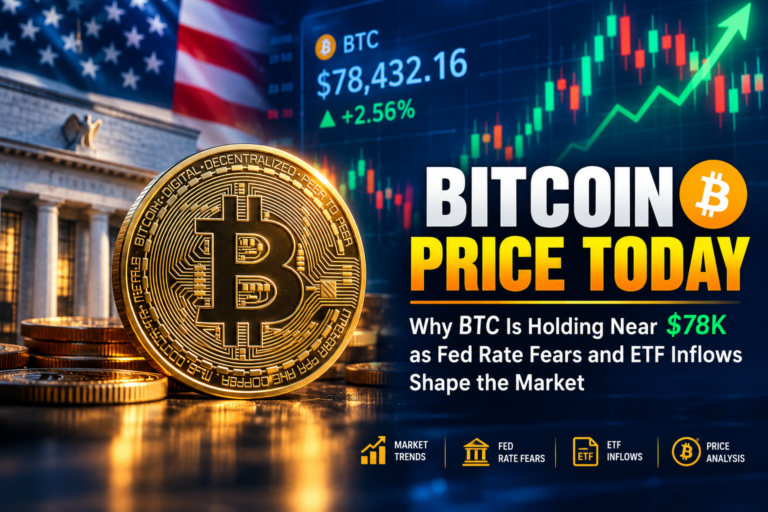
Bitcoin has once again reminded investors that cryptocurrency markets can change direction quickly. After trading significantly higher earlier in the year, Bitcoin has fallen back toward the low-$60,000 range in August 2026. Recent market reports have placed BTC around $62,000–$64,000, well below its October 2025 record near $126,000.
So, why is Bitcoin dropping?
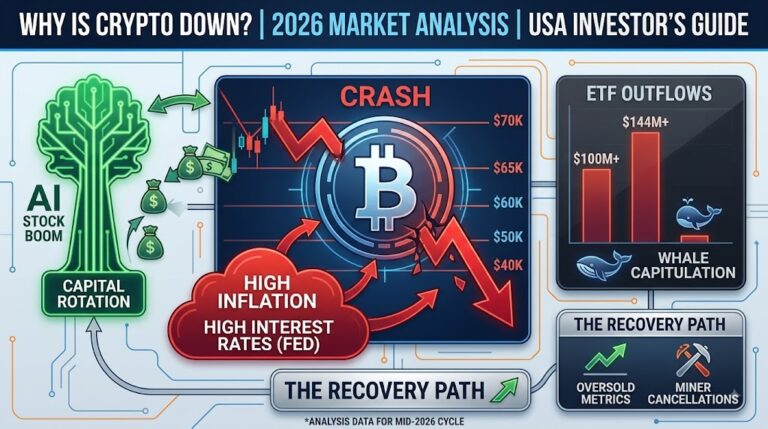
The answer is not one single event. Bitcoin‘s latest decline is the result of several factors working together, including weaker risk appetite, continued pressure from crypto investment products, uncertainty surrounding U.S. interest rates, regulatory disappointment, geopolitical concerns, technical resistance, and a broader shift in investor capital.
For new investors, a falling Bitcoin price can be confusing. Headlines may point to one reason today and another tomorrow. In reality, Bitcoin is influenced by a combination of macroeconomic conditions, investor psychology, liquidity, institutional activity, and market structure.
This article explains the major reasons behind Bitcoin’s current weakness and what investors should watch next.
Bitcoin Is Coming Down From a Major High
One of the most important points to understand is where Bitcoin came from.
Bitcoin reached a record high of roughly $126,000 in October 2025. By August 2026, BTC was trading around the $63,000 area, meaning the cryptocurrency had lost roughly half of its value from that peak.
That does not necessarily mean something has suddenly gone wrong with Bitcoin itself.
Large corrections are a normal part of cryptocurrency market cycles. Bitcoin has historically experienced periods in which prices rise rapidly, become overextended, and then go through a long period of consolidation or decline.
After a major rally, early investors may decide to lock in profits. Once selling begins, traders who bought at higher prices can become nervous, while leveraged traders may be forced to close positions. This can create additional selling pressure.
The result can be a decline that appears much larger than the original trigger.
1. Bitcoin ETF Outflows Are Creating Selling Pressure
One of the biggest factors investors are watching right now is the flow of money into and out of Bitcoin exchange-traded funds.
Bitcoin ETFs have become an important bridge between traditional financial markets and cryptocurrency. When investors buy shares of spot Bitcoin ETFs, the funds can create demand for Bitcoin. When investors pull money out, that demand can weaken.
Recent reports have pointed to continued ETF outflows as one factor behind Bitcoin’s August weakness.
This matters because institutional flows can be much larger than the activity of individual traders.
If investors are becoming more cautious, they may reduce exposure to Bitcoin ETFs rather than buying the dip. That can remove an important source of demand from the market.
However, ETF flows should not be viewed in isolation. A single day of outflows does not automatically mean Bitcoin is entering a long-term bear market. Investors should look at the broader trend over multiple days and weeks.
2. Investors Are Becoming More Cautious About Risk
Bitcoin is often described as an alternative asset, but its price can behave like a risk asset when investors are worried about the economy or financial markets.
When confidence is high, investors may be willing to take more risk. They may buy technology stocks, cryptocurrencies, growth companies, and other assets with the potential for higher returns.
When uncertainty rises, the opposite can happen.
Investors may move toward cash, bonds, defensive assets, or other investments they believe carry less risk.
This risk-off behavior can put pressure on Bitcoin even when there has been no major negative development inside the Bitcoin network itself.
Recent market coverage has highlighted geopolitical uncertainty and investor caution as contributors to Bitcoin’s inability to sustain higher levels.
3. Interest Rates and Federal Reserve Expectations Still Matter
Another major reason Bitcoin is dropping is uncertainty about monetary policy.
Interest rates influence how investors value risk across financial markets. When interest rates are high, safe assets can become more attractive because investors can earn comparatively strong returns without taking as much risk.
Bitcoin does not pay interest.
That means investors may be less willing to hold a highly volatile asset when yields elsewhere look attractive.
The Federal Reserve’s future decisions therefore remain important for Bitcoin.
Interestingly, recent U.S. inflation data has provided some positive signals. July consumer inflation was reported at 3.4%, while producer prices were unchanged in the latest data discussed by market analysts.
Normally, cooling inflation could support expectations for easier monetary policy, which can be positive for risk assets.
But Bitcoin has not responded strongly to that potential positive catalyst.
That tells us something important: Bitcoin’s current weakness cannot be explained by interest rates alone.
Other forces, particularly ETF flows, regulation, market positioning, and technical resistance, are also influencing prices.
4. Regulatory Uncertainty Is Hurting Market Confidence
Regulation has always been a major issue for cryptocurrency investors.
The crypto industry has spent years waiting for clearer rules in the United States. Investors generally prefer regulatory certainty because clear rules can make it easier for companies, financial institutions, and investment funds to participate in the market.
Recently, however, expectations for major U.S. crypto legislation have weakened.
Reports indicate that progress on the proposed Clarity Act has been delayed, while an SEC meeting related to cryptocurrency rules was unexpectedly canceled. The change in expectations has contributed to negative sentiment in the crypto market.
This does not mean Bitcoin has suddenly become illegal or that cryptocurrency regulation is going away.
Instead, the problem is uncertainty.
Markets tend to dislike uncertainty because investors cannot easily determine what rules, costs, or opportunities will exist in the future.
When regulatory optimism fades, some investors may decide to reduce their positions until there is more clarity.
5. Bitcoin Has Struggled to Break Important Resistance Levels
Technical analysis also helps explain why Bitcoin is having difficulty recovering.
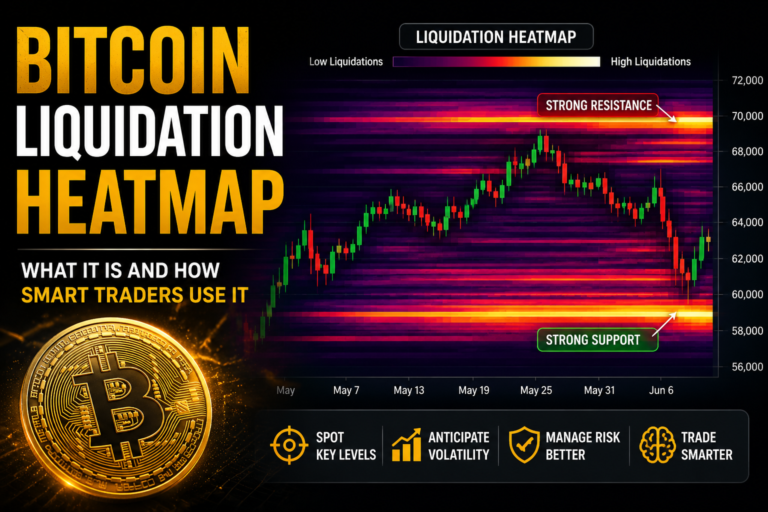
Bitcoin has repeatedly struggled around the mid-$60,000 area. Recent analysis has highlighted resistance around $65,000 and a broader resistance zone extending toward $70,000.
Why does resistance matter?
Imagine thousands of investors purchased Bitcoin around $65,000. If Bitcoin later falls to $60,000 and then returns to $65,000, some of those investors may decide to sell because they finally have the opportunity to exit near their original purchase price.
That creates additional selling pressure.
Technical traders also watch moving averages, support levels, trading volume, and previous highs and lows.
When Bitcoin fails to reclaim an important level, traders can interpret that as a sign that buyers are not strong enough yet.
This can encourage additional short-term selling.
6. Leverage Can Make Bitcoin’s Decline Worse
Bitcoin’s price can fall because of normal selling, but leverage can make the move much more dramatic.
Many cryptocurrency traders use borrowed money or derivatives to increase their exposure.
For example, someone who controls $100,000 worth of Bitcoin with only $20,000 of their own capital is highly leveraged. If Bitcoin falls sharply, the trader may be forced to close the position.
When many leveraged positions are liquidated at the same time, forced selling can push Bitcoin even lower.
This can create a chain reaction:
Bitcoin falls → leveraged positions are liquidated → more Bitcoin is sold → price falls further → additional liquidations occur.
That is one reason cryptocurrency declines can sometimes happen much faster than traditional stock-market declines.
Leverage is not necessarily the original cause of a Bitcoin sell-off, but it can significantly increase the size and speed of the move.
7. Investors Are Rotating Money Into Other Opportunities
Capital does not always leave financial markets completely. Sometimes it simply moves from one opportunity to another.
Recent reporting has highlighted increased investor interest in artificial intelligence and technology-related investments while some investors have reduced cryptocurrency exposure.
This is important because investors constantly compare potential returns.
If a trader believes an AI stock, technology company, bond, or another asset offers a better risk-to-reward opportunity than Bitcoin, that trader may reduce their BTC position.
When enough investors make the same decision, Bitcoin can experience persistent selling pressure.
This does not necessarily mean investors have permanently abandoned cryptocurrency. Capital can rotate back into Bitcoin if market conditions change.
8. Geopolitical Risk Is Adding More Uncertainty
Global events can also influence Bitcoin.
Cryptocurrency markets operate 24 hours a day, seven days a week, so Bitcoin can react to international developments almost immediately.
Recent market coverage has pointed to geopolitical tensions in the Middle East and concerns surrounding global trade and energy markets as factors contributing to investor caution.
During periods of geopolitical uncertainty, investors often become more conservative.
Some traders reduce exposure to volatile assets while waiting for events to become clearer.
Bitcoin’s reputation as a “digital gold” asset does not mean it will always rise during geopolitical crises. In the short term, Bitcoin can behave like a risk asset and fall alongside stocks and other speculative investments.
9. Bitcoin’s Market Cycle May Be Playing a Role
Bitcoin’s historical market cycles are another factor worth considering.
Bitcoin has experienced several major bull markets followed by significant corrections. These cycles are influenced by investor psychology, liquidity, adoption, speculation, and the Bitcoin halving cycle.
The 2025 record high was followed by a substantial decline into 2026. Some market analysts now describe the market as being in a broader bearish or corrective phase.
That does not guarantee that Bitcoin will continue falling.
Market cycles are not clocks. They do not tell investors exactly when a bottom will occur or when the next bull market will begin.
Instead, they provide historical context.
A major rally can create excessive optimism. Once prices begin falling, that optimism can quickly turn into fear.
10. Market Sentiment Has Become Bearish
Investor psychology is one of the most powerful forces in cryptocurrency.
When Bitcoin rises, investors become excited. Rising prices attract media attention, new buyers enter the market, and positive expectations become stronger.
The reverse can happen during a decline.
Falling prices create fear. Investors start wondering whether the decline will continue. Some sell to protect their capital, while others wait for a lower entry price.
That creates a self-reinforcing cycle.
Current market sentiment around Bitcoin has been described as bearish in several market analyses, although sentiment can change quickly.
This is why investors should avoid making decisions based solely on headlines.
Fear can push Bitcoin below levels that may eventually prove attractive to long-term buyers. Likewise, extreme optimism can push prices to levels that become difficult to sustain.
Is Bitcoin Crashing or Simply Correcting?
The word “crash” gets used frequently in cryptocurrency headlines, but not every decline is a crash.
Bitcoin has fallen substantially from its October 2025 high, but the market is still functioning normally. Bitcoin continues to trade globally, and the network itself continues operating.
A 5% daily decline may feel dramatic, but cryptocurrency investors have historically experienced much larger moves.
The more important question is whether Bitcoin can establish a stable base and begin making higher highs and higher lows.
If BTC continues making lower lows and repeatedly fails to recover important resistance levels, bearish pressure could remain.
If buyers return and Bitcoin begins reclaiming major resistance zones with strong volume, sentiment could change quickly.
What Should Bitcoin Investors Watch Next?
If you’re trying to understand why Bitcoin is dropping, it is useful to monitor several indicators instead of focusing on a single headline.
Bitcoin ETF Flows
Watch whether institutional investment products are experiencing sustained inflows or outflows.
Consistent inflows could signal renewed demand, while persistent outflows may continue creating pressure.
Federal Reserve Policy
Keep an eye on inflation, employment data, interest-rate expectations, and Federal Reserve statements.
Changes in expectations for monetary policy can influence the entire risk-asset market.
Bitcoin Trading Volume
Price movements accompanied by strong volume are generally more meaningful than moves occurring on unusually low volume.
A recovery supported by stronger buying activity would be more convincing than a brief price bounce.
Key Price Levels
Bitcoin’s ability to reclaim resistance around the mid-$60,000 area will be important for short-term sentiment. Analysts have also been watching support around the low-$60,000 range.
These levels are not guaranteed floors or ceilings, but they can help traders understand where buyers and sellers have historically become more active.
Regulatory Developments
Any meaningful progress on U.S. cryptocurrency legislation could affect sentiment.
Positive regulatory news could encourage institutional participation, while additional delays may keep investors cautious.
Will Bitcoin Go Back Up?
Nobody can say with certainty when Bitcoin will recover.
Bitcoin has recovered from major declines before, but previous performance does not guarantee future results.
For Bitcoin to establish a stronger recovery, several things could help: sustained ETF inflows, improving liquidity, stronger institutional demand, favorable monetary conditions, clearer regulation, and a return of positive market sentiment.
On the other hand, Bitcoin could remain under pressure if ETF outflows continue, geopolitical risks increase, regulatory uncertainty persists, or investors continue moving capital toward other assets.
The most important point is that a lower Bitcoin price does not automatically mean the asset is finished.
Markets move in cycles.
Final Thoughts: Why Is Bitcoin Dropping?
So, why is Bitcoin dropping?
The current decline appears to be the result of multiple factors rather than one specific event. Bitcoin is dealing with ETF outflows, cautious investor sentiment, regulatory uncertainty, technical resistance, geopolitical risks, leverage, capital rotation, and the broader market cycle.
Recent reports have placed Bitcoin around the $62,000–$64,000 range in mid-August 2026, while the cryptocurrency remains far below its 2025 record near $126,000.
However, investors should avoid assuming that today’s decline automatically predicts tomorrow’s price.
Bitcoin can move rapidly in both directions.
For long-term investors, the better approach is to understand the forces driving the market rather than reacting emotionally to every red candle. Monitor ETF flows, macroeconomic data, Federal Reserve expectations, regulation, market liquidity, and Bitcoin’s key technical levels.
Most importantly, remember that cryptocurrency remains a highly volatile asset. A strong rally can create substantial gains, but a major decline can happen just as quickly.
The current Bitcoin weakness is therefore not simply a story about Bitcoin itself. It is a story about liquidity, investor confidence, regulation, global markets, and the constant battle between buyers and sellers.
As those factors change, Bitcoin’s direction can change with them.
This article is for educational and informational purposes only and should not be considered financial or investment advice. Cryptocurrency prices are highly volatile, and readers should conduct their own research and consider their individual risk tolerance before making investment decisions.
Website: BitcoinVPro