Crypto News: Bitcoin, Ethereum, ETFs, Regulation, and the Latest Market Trends
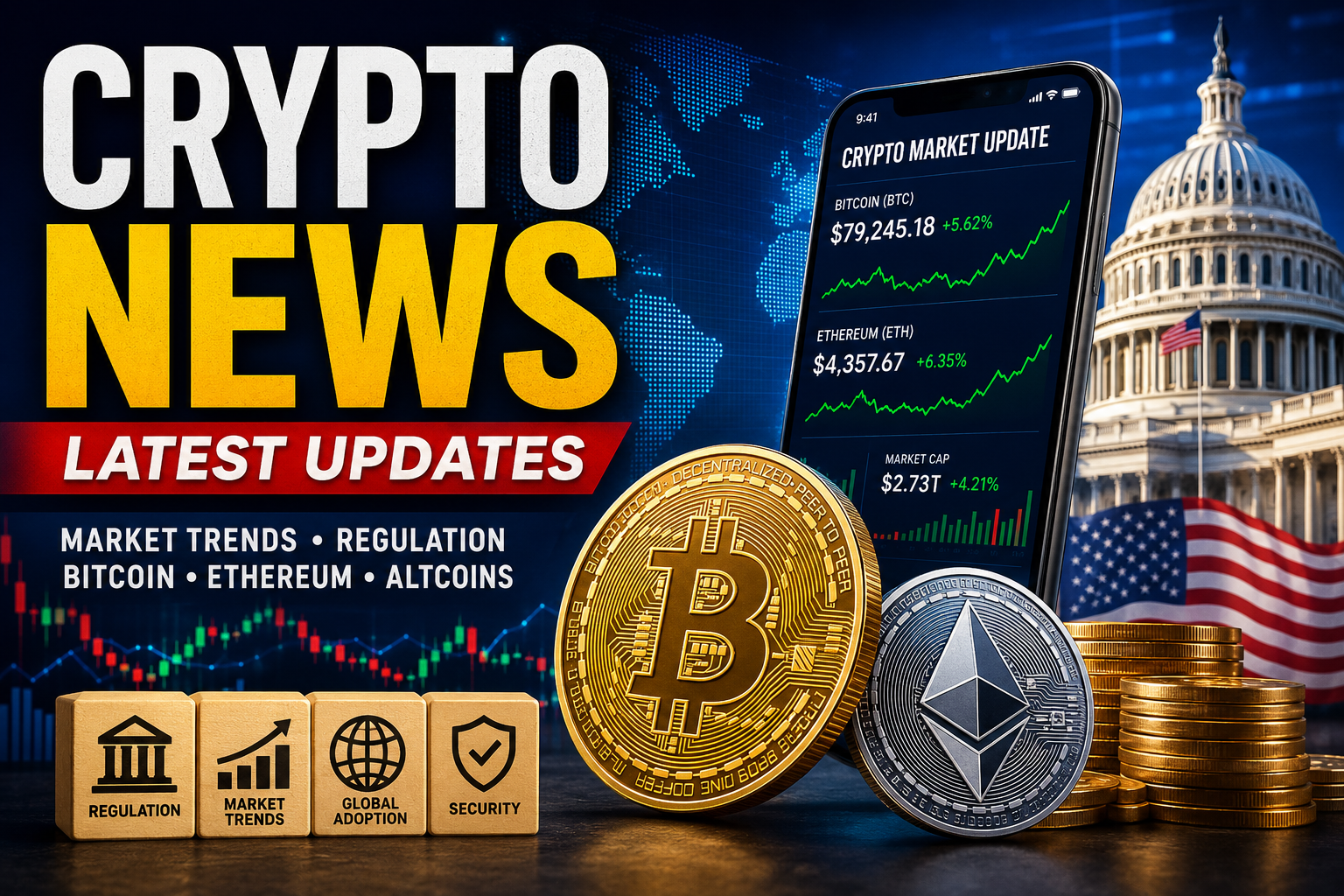
After a period of uncertainty and heavy volatility, Bitcoin and other major cryptocurrencies have recently staged a powerful rebound. Bitcoin briefly moved above $79,000 during the week, while Ethereum also posted a significant gain. At the same time, U.S. spot Bitcoin and Ethereum exchange-traded funds attracted billions of dollars in fresh capital, giving the market another sign that institutional interest remains strong.
Regulation is also becoming an increasingly important part of the story.
The U.S. Securities and Exchange Commission has already taken steps in 2026 to clarify how federal securities laws apply to different types of crypto assets. Meanwhile, lawmakers continue working on broader cryptocurrency market-structure legislation.
For American investors, this combination of price momentum, ETF demand, regulation, and changing macroeconomic conditions could make the rest of 2026 an important period for digital assets.
In this latest crypto news guide, we look at the major developments shaping the market and explain what they could mean for Bitcoin, Ethereum, altcoins, ETFs, crypto companies, and everyday U.S. investors.
Bitcoin Leads the Latest Crypto Market Rally
Bitcoin is once again at the center of the cryptocurrency market.
During the latest weekly rally, Bitcoin gained more than 20%, briefly trading above $79,000 before settling back somewhat. The move represented Bitcoin’s strongest weekly performance in roughly two years, according to recent market reporting.
This is significant because Bitcoin’s price action often influences the rest of the cryptocurrency market.
When Bitcoin moves sharply higher, traders frequently begin looking for opportunities in Ethereum and other major altcoins. That appears to be happening again.
The latest rally was not driven by just one factor. Instead, several developments came together at approximately the same time:
- Strong U.S. spot Bitcoin ETF inflows
- Increased Ethereum ETF demand
- Changing expectations around U.S. crypto regulation
- Broader financial-market liquidity expectations
- Renewed investor confidence
- Strong momentum across major digital assets
The combination created a powerful shift in market sentiment.
However, investors should remember that cryptocurrency markets can reverse quickly. A strong weekly rally does not automatically mean that prices will continue moving higher.
U.S. Bitcoin ETFs See Major Inflows
One of the biggest stories in the latest crypto news is the renewed demand for spot Bitcoin ETFs.
U.S. spot Bitcoin ETFs attracted approximately $1.9 billion in net inflows during the latest reported week, according to The Block’s analysis of SoSoValue data. That was the strongest weekly inflow for the category since October 2025.
The funds also experienced a dramatic increase in trading activity.
Bitcoin ETF trading volume climbed to approximately $22.1 billion for the week, compared with $6.9 billion during the previous week. The funds’ combined assets under management also increased significantly as Bitcoin prices climbed.
This matters because ETFs have changed how many traditional investors access Bitcoin.
Instead of creating a crypto wallet, transferring funds to a cryptocurrency exchange, and managing private keys, investors can gain Bitcoin exposure through a brokerage account using a regulated exchange-traded product.
For many U.S. investors, that convenience can make digital assets easier to access.
It also means that Bitcoin’s price is increasingly connected to traditional investment flows.
Ethereum ETFs Are Gaining Momentum
Bitcoin isn’t the only cryptocurrency benefiting from increased ETF demand.
U.S. spot Ethereum ETFs also recorded a strong week, attracting approximately $697.2 million in net inflows, their strongest weekly result since October 2025.
Ethereum’s ETF market has therefore become another important indicator for crypto investors.
Ethereum has a different investment story from Bitcoin.
Bitcoin is often viewed as a scarce digital asset or store-of-value alternative, while Ethereum is closely connected to blockchain applications, smart contracts, decentralized finance, tokenization, and other digital infrastructure.
Because of that difference, investors may view the two assets differently.
The recent Ethereum rally also helped improve sentiment throughout the broader altcoin market.
XRP and Other Altcoins Join the Rally
Bitcoin’s strength has also spread into other parts of the crypto market.
XRP was among the notable performers during the latest rally, gaining close to 40% over the reported week. Other cryptocurrencies also benefited as traders moved beyond Bitcoin and Ethereum.
This type of market behavior is common during periods of improving crypto sentiment.
Investors often start with Bitcoin because it is the largest and most established cryptocurrency. Once confidence improves, capital can move toward Ethereum and then into smaller digital assets.
That can create what traders call an altcoin rally.
But altcoins also carry considerably different risk profiles.
A smaller cryptocurrency can rise much faster than Bitcoin, but it can also lose a large percentage of its value just as quickly.
For U.S. investors, understanding that difference is critical.
A cryptocurrency’s recent performance should never be the only reason to buy it.
U.S. Crypto Regulation Remains a Major Story
Price is only half of the current crypto news story.
Regulation is arguably just as important.
In March 2026, the SEC issued an interpretation explaining how federal securities laws apply to certain crypto assets and transactions. The agency said the interpretation establishes a clearer framework around categories including digital commodities, digital collectibles, digital tools, stablecoins, and digital securities.
The SEC also addressed issues involving staking, airdrops, protocol mining, and wrapped crypto assets.
This is important because regulatory uncertainty has been one of the biggest challenges facing cryptocurrency companies operating in the United States.
For years, businesses and investors have struggled with questions such as:
- Is a particular crypto asset a security?
- Is it a commodity?
- Which regulator has jurisdiction?
- What rules apply to exchanges?
- How should crypto companies register?
- How should certain token offerings be structured?
Clearer rules could make it easier for legitimate businesses to operate.
At the same time, regulation can create additional compliance responsibilities.
SEC Proposes New Crypto Offering Rules
The regulatory story has continued to develop.
The SEC recently proposed a new framework called Regulation Crypto Assets.
According to the SEC proposal, the framework would create a tailored offering regime for certain investment contracts involving crypto assets. The proposal includes exemptions for certain offerings and would also establish a conditional safe harbor related to the term “investment contract.”
One proposed exemption would cover offerings of up to $5 million over a four-year period.
Another would cover offerings of up to $75 million during a 12-month period, subject to additional disclosure and reporting requirements.
These are proposals rather than final rules, so investors and crypto businesses should not treat them as permanent law.
Still, the development shows that U.S. regulators are working toward a more defined framework for the digital asset industry.
The CLARITY Act Remains Important
Another major subject in U.S. crypto news is the proposed CLARITY Act.
The legislation is intended to provide greater clarity around the regulatory treatment of digital assets, including the distinction between assets that should fall under securities laws and those that should be treated more like commodities.
President Donald Trump has publicly pushed Congress to move forward with the legislation, adding political attention to the debate. Recent reporting indicates that the legislation faces disagreements over issues including provisions concerning political figures and crypto-related conflicts of interest.
For cryptocurrency businesses, the potential impact is significant.
Clearer market rules could influence where companies establish operations, how exchanges structure their services, and how token projects approach fundraising.
For investors, regulatory clarity could potentially reduce uncertainty.
But legislation can take time, and proposed laws can change significantly before final passage.
Stablecoins Are Becoming More Important
Stablecoins are another major area to watch in crypto news.
Unlike Bitcoin or many altcoins, stablecoins are designed to maintain a relatively stable value, typically by referencing a fiat currency such as the U.S. dollar.
The U.S. government has already taken significant steps toward establishing a federal regulatory framework for stablecoins.
The GENIUS Act, signed into law in 2025, created federal requirements for payment stablecoins, including reserve and disclosure requirements. The White House said the legislation requires qualifying stablecoins to be backed by liquid assets such as U.S. dollars and short-term Treasury securities.
Why does this matter?
Stablecoins are increasingly used for:
- Crypto trading
- Cross-border payments
- Digital transfers
- DeFi applications
- Settlement
- On-chain transactions
- Dollar-based digital finance
If stablecoin adoption continues expanding, it could become one of the most important bridges between traditional finance and blockchain technology.
The U.S. Is Taking a Bigger Role in Digital Assets
The United States has increasingly positioned itself as a major center for cryptocurrency and blockchain innovation.
In March 2025, the White House established a Strategic Bitcoin Reserve and a U.S. Digital Asset Stockpile. The executive order directed the government to manage certain Bitcoin and other digital assets already held through forfeiture proceedings.
The order also established a policy framework for managing the government’s Bitcoin holdings.
This is a major development because it demonstrates that Bitcoin is no longer being discussed only as a private-sector investment.
Government policy has become part of the cryptocurrency conversation.
For American investors, that makes developments in Washington increasingly relevant to the crypto market.
Why Macroeconomics Still Matters for Crypto
Even though cryptocurrency is based on blockchain technology, crypto prices do not exist in isolation.
Bitcoin and other digital assets can react strongly to:
- Interest-rate expectations
- Inflation
- Treasury yields
- The U.S. dollar
- Stock-market performance
- Liquidity
- Investor risk appetite
- Federal Reserve policy
Recent crypto gains have occurred alongside broader changes in financial-market expectations.
For example, recent market reporting linked part of the crypto rally to Treasury market developments and increased expectations that financial conditions could become more supportive of risk assets.
This is why serious crypto investors should follow both cryptocurrency-specific news and traditional financial news.
A major Federal Reserve announcement can sometimes matter more for Bitcoin in the short term than a new blockchain upgrade.
What Does the Latest Crypto News Mean for U.S. Investors?
For American investors, the current market presents both opportunities and risks.
The positive side is that cryptocurrency is becoming increasingly integrated into traditional finance.
Spot ETFs provide easier access.
Regulatory agencies are creating clearer frameworks.
Stablecoin legislation is establishing formal rules.
Institutional participation remains significant.
And blockchain technology continues to expand into areas such as payments, financial infrastructure, tokenization, and decentralized applications.
But there are still substantial risks.
Crypto prices can move dramatically within hours.
ETF inflows can reverse.
Regulatory proposals can change.
Individual tokens can lose most of their value.
Crypto companies can experience security incidents.
And investors can still fall victim to scams and fraudulent platforms.
Therefore, investors should avoid making decisions based solely on headlines.
How to Follow Crypto News More Effectively
There is an enormous amount of cryptocurrency information online.
Not all of it is reliable.
Social media can be useful for discovering breaking developments, but it can also spread rumors quickly.
A better strategy is to verify important information through multiple sources.
When you see a major crypto headline, ask:
Who reported it?
Look for established financial publications, official government sources, company announcements, and primary documents.
Is it confirmed?
A social media post is not necessarily confirmation.
Is it a proposal or a final decision?
This is especially important with cryptocurrency regulation.
What is the financial impact?
Not every piece of crypto news will affect prices.
Is the source trying to sell something?
Be particularly careful with articles or social media accounts that promise guaranteed profits.
Good crypto research separates information from promotion.
Bitcoin and Ethereum Could Remain the Main Market Drivers
Despite the growing number of cryptocurrencies, Bitcoin and Ethereum remain the most important assets to watch.
Bitcoin continues to dominate institutional attention through spot ETFs and its role as the largest cryptocurrency by market value.
Ethereum remains important because of its smart-contract ecosystem and growing ETF market.
If both assets continue attracting capital, the broader cryptocurrency market could benefit.
However, investors should also watch whether ETF inflows remain strong after the latest surge.
A single strong week is encouraging, but a sustained trend is more meaningful.
The market will likely be watching ETF flows, interest rates, regulatory developments, and institutional demand closely.
What Could Happen Next in Crypto?
Nobody knows exactly where Bitcoin or the broader crypto market will go next.
That is an important point because cryptocurrency price predictions often sound more certain than they actually are.
The current environment does provide several signals worth watching.
Continued ETF Demand
If U.S. spot Bitcoin and Ethereum ETFs continue attracting significant capital, that could provide an important source of demand.
Regulatory Progress
Further movement on U.S. crypto legislation could reduce uncertainty for businesses and investors.
Stablecoin Expansion
Stablecoin adoption could strengthen the connection between traditional finance and blockchain networks.
Institutional Adoption
Banks, asset managers, corporations, and other financial institutions may continue experimenting with digital assets.
Macroeconomic Conditions
Interest rates, inflation, liquidity, and the U.S. dollar could continue influencing crypto valuations.
These factors will likely remain central to crypto news throughout the rest of 2026.
Final Thoughts
The latest crypto news shows that the digital asset market is entering another important phase.
Bitcoin has delivered a powerful recent rally, while Ethereum and several major altcoins have also gained momentum. U.S. spot Bitcoin and Ethereum ETFs recorded their strongest combined weekly inflows of 2026 so far, with approximately $2.6 billion entering the products during the latest reported week.
At the same time, the regulatory environment is evolving.
The SEC has issued new interpretive guidance, proposed additional crypto-specific rules, and continues working toward a clearer framework. Meanwhile, broader legislation such as the CLARITY Act remains an important issue for the U.S. digital asset industry.
For American investors, the biggest takeaway is simple: crypto is becoming more connected to traditional finance and U.S. financial policy, but it remains a high-risk market.
Bitcoin and Ethereum may continue receiving significant institutional attention, ETFs may remain an important source of demand, and regulation could reshape how crypto companies operate in the United States.
But strong market performance should never be confused with guaranteed future returns.
The smartest approach is to follow reliable sources, understand the risks, verify major claims, and make financial decisions based on your own research rather than social media hype.
As the crypto market continues evolving, BitcoinVPro will remain focused on the developments that matter most to investors—from Bitcoin and Ethereum to ETFs, blockchain technology, regulation, and the wider digital asset economy.
Frequently Asked Questions
What is the latest crypto news?
Recent crypto news has been dominated by a strong Bitcoin and Ethereum rally, large U.S. spot ETF inflows, renewed altcoin momentum, and continued developments in U.S. cryptocurrency regulation.
Why is Bitcoin rising?
The latest rally has coincided with strong U.S. spot Bitcoin ETF inflows, improved investor sentiment, broader financial-market developments, and renewed optimism around U.S. crypto regulation.
Are Bitcoin ETFs still attracting money?
Yes. U.S. spot Bitcoin ETFs recorded approximately $1.9 billion in net inflows during the latest reported week, according to The Block’s analysis of SoSoValue data.
Is Ethereum also gaining?
Yes. U.S. spot Ethereum ETFs attracted approximately $697.2 million in net inflows during the same week, their strongest weekly inflow since October 2025.
Is cryptocurrency regulated in the United States?
Yes, but the regulatory framework is evolving. The SEC issued an interpretation in March 2026 explaining how federal securities laws apply to various crypto assets and transactions, while additional legislation and proposed rules are being considered.
Is crypto a safe investment?
Cryptocurrency remains a high-risk asset class. Prices can rise or fall dramatically, and individual projects can fail. Investors should conduct independent research and only risk money they can afford to lose.
Disclaimer: This article is for educational and informational purposes only. It is not financial, investment, tax, or legal advice. Cryptocurrency markets are highly volatile, and past performance does not guarantee future results. Always conduct your own research and consider consulting a qualified financial professional before making investment decisions.




One Comment