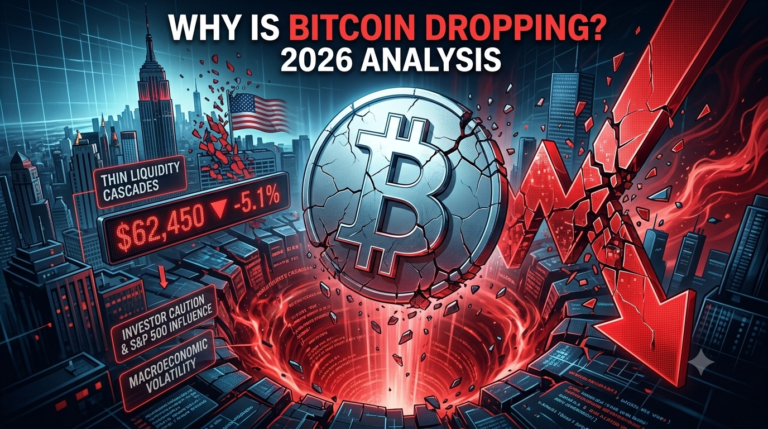

Navigating the Bitcoin Crash: Understanding Market Volatility and Risk Management in 2026
Understand why Bitcoin is crashing in 2026. Explore the factors driving market volatility, institutional trends, and essential risk management strategies for US investors.
The cryptocurrency market is no stranger to turbulence, but the recent market activity in 2026 has left even seasoned investors questioning the long-term trajectory of Bitcoin. After reaching record highs in late 2025, the market has faced a significant correction, erasing trillions in value. For US-based investors, navigating this “Bitcoin crash” requires moving beyond the hype and understanding the complex, interconnected forces of institutional capital, geopolitical tension, and shifting macroeconomic priorities.
The Anatomy of the 2026 Bitcoin Downturn
The recent decline in Bitcoin’s price—down nearly 30% year-to-date—is not the result of a single event but rather a “perfect storm” of selling pressure. To understand the current market, we must look at the primary drivers:
1. The Shift to AI and Tech Stocks
Perhaps the most significant structural change in the 2026 market is the pivot of institutional and retail capital toward Artificial Intelligence (AI) and technology sectors. As the Nasdaq-100 continues to show robust performance, Bitcoin has struggled to compete for capital. Investors, particularly those with a shorter time horizon, are increasingly viewing crypto as a “contrarian bet” rather than the high-growth vehicle it was perceived to be during the previous bull run.
2. ETF Outflows and Institutional Selling
Spot Bitcoin ETFs, once hailed as the ultimate validator of institutional demand, have become a double-edged sword. As institutional portfolios rebalance in response to changing risk metrics, these ETFs have seen consistent net outflows. For example, the iShares Bitcoin Trust (IBIT) experienced over $1.2 billion in net outflows during a single week in June 2026. When major players like Strategy—a prominent corporate backer—liquidate portions of their holdings, it signals a shift in sentiment that ripples through the entire ecosystem.
3. Geopolitical Tensions and Inflationary Pressures
Global instability, particularly the ongoing U.S.-Iran conflict, has acted as a catalyst for market anxiety. Geopolitical tensions have driven up crude oil prices, fueling inflation and forcing the Federal Reserve to reconsider its rate-cut timeline. Because Bitcoin is often treated by traders as a “risk-on” asset, it is typically among the first to be sold off when investors fear that high interest rates will remain in place for longer than anticipated.
4. Derivatives Liquidations
The volatility is often amplified by the derivatives market. A significant portion of the recent price drop was accelerated by forced liquidations in the crypto futures market, where roughly $1.8 billion in long positions were wiped out in just 24 hours. This creates a cascading effect: as prices dip, leveraged positions are automatically closed, forcing more selling and pushing prices even lower in a feedback loop.
Analyzing Volatility: A Guide for US Investors
Volatility is inherent to the digital asset class, but it is not unmanageable. By utilizing the right frameworks, investors can gain a clearer perspective on whether a market movement is noise or a signal for a fundamental change.
The “Fear” Metrics
Investors should monitor volatility indices (similar to the VIX in equity markets) and sentiment indicators. When the market hits “extreme fear” levels, it often signals an oversold state, suggesting that the most aggressive selling may be nearing exhaustion. Monitoring metrics like the Relative Strength Index (RSI) and Bitcoin production costs (miner break-even points) can help identify potential support levels.
Regulatory Clarity
In the United States, regulatory uncertainty—such as the debates surrounding the Clarity Act—continues to weigh on market sentiment. While the legislative environment has improved compared to previous years, investors remain hesitant to deploy significant capital until there is a clear, long-term legal framework for digital assets. Watching for “forward visibility” from regulators is key to anticipating the next institutional wave.
Mastering Crypto Risk Management in 2026
In an environment characterized by sudden drawdowns, “HODLing” without a plan is often insufficient. Effective risk management is the difference between surviving a cycle and losing one’s portfolio.
The 1-2% Rule
Professional traders adhere strictly to the rule of never risking more than 1-2% of their total trading capital on any single position. This ensures that even during massive market swings, the overall portfolio remains resilient.
Stop-Loss Discipline
Stop-loss orders are non-negotiable for anyone trading in volatile conditions. Whether you place them based on technical support levels or the Average True Range (ATR) to account for “market noise,” the key is to define your exit before you enter the trade. Never adjust a stop-loss downward simply to avoid taking a loss—this is the most common way accounts are liquidated.
Dollar-Cost Averaging (DCA)
For long-term investors, DCA remains the gold standard for reducing timing risk. By automating consistent, periodic purchases regardless of price, you smooth out the impact of volatility over time, removing the emotional stress of trying to “time the bottom”.
Diversification Beyond Crypto
The 2026 crash serves as a reminder that crypto should be one component of a broader, diversified portfolio. A balanced strategy might include a 60-30-10 framework (or similar allocation) that spreads risk across traditional equities, fixed-income assets, and digital assets. This prevents “crypto-exclusive” shocks from devastating your entire net worth.
Conclusion: The Path Forward
The Bitcoin crash of 2026 is a sobering reminder that digital assets remain a high-risk, high-reward proposition. While the headlines focus on the liquidation of positions and the exodus of ETF capital, the underlying technology remains intact. For the long-term US investor, the current market represents a transition period. The “hype” phase has largely faded, replaced by a need for fundamental analysis and rigorous risk management.
Bitcoin is changing, and so are the investors who succeed in this space. By focusing on asset security, maintaining a long-term perspective, and refusing to succumb to the “Fear, Uncertainty, and Doubt” (FUD) that defines market bottoms, investors can navigate this volatility with composure. The market may be in a state of flux, but for those with a defined strategy, it remains an asset class ripe with opportunity.